


 русский
Understanding the Mechanics of Seamless Rolled Ring Forging
Ring type forging, specifically the seamless rolled ring process, is a specialized manufacturing technique used to create high-strength, circular components. Unlike welded rings, which are formed by bending a bar and joining the ends, seamless rings are produced through a process that starts with a solid metal "donut." This preform is subjected to intense pressure between a series of rollers—including a main roll, an idler roll, and axial cones—which simultaneously reduce the wall thickness and increase the diameter. This mechanical deformation ensures that the grain flow of the metal is oriented circumferentially, providing superior structural integrity and resistance to fatigue.
The Role of Grain Flow in Ring Strength
The primary advantage of ring type forging over centrifugal casting or machining from plate is the development of a continuous grain flow. During the rolling process, the internal crystalline structure of the metal is realigned to follow the contour of the ring. This eliminates planes of weakness, making the component significantly more resilient to impact and high-pressure environments. For industries like aerospace or oil and gas, this directional strength is a non-negotiable safety requirement.
Critical Material Selection for Forged Rings
The versatility of ring type forging allows for the use of a wide spectrum of ferrous and non-ferrous alloys. Choosing the right material depends on the final application's thermal, chemical, and mechanical demands. Carbon steels are often used for general industrial flanges, while superalloys are reserved for the extreme heat of turbine engines.
| Material Category | Common Grades | Primary Application |
| Carbon Steel | A105, 1045 | Piping Flanges & Gears |
| Alloy Steel | 4140, 4340 | Heavy Equipment Bearings |
| Stainless Steel | 304L, 316L, 17-4 PH | Food Processing & Marine |
| Superalloys | Inconel 718, Hastelloy | Jet Engine Components |
Step-by-Step Manufacturing Workflow
Precision in ring forging is achieved through a controlled sequence of thermal and mechanical stages. Each step must be monitored to ensure the final ring meets dimensional tolerances and metallurgical standards.
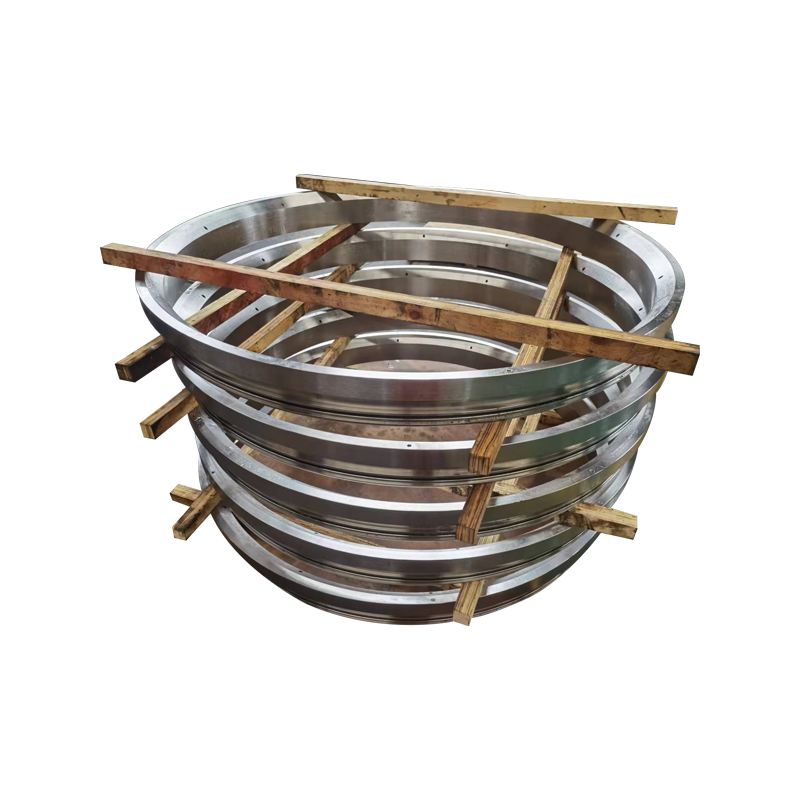
- Upsetting: The starting ingot or billet is heated to forging temperature and compressed vertically to decrease its height and increase its diameter.
- Piercing: A punch is driven through the center of the upset hot metal to create a hole, forming the "donut" or hollow preform.
- Ring Rolling: The preform is placed over the idler roll and moved toward the driver roll. As the rolls rotate, the wall thickness is squeezed, forcing the ring to expand in diameter.
- Heat Treatment: Post-forging processes like annealing, quenching, or tempering are applied to achieve the desired hardness and ductility.
Industrial Applications and Benefits
Ring type forging is preferred in sectors where component failure is not an option. Because the process minimizes material waste compared to machining a solid block (which would result in a large amount of scrap from the center hole), it is also a cost-effective solution for high-volume production of circular parts.
Key Advantages of Forged Rings
- High Pressure Tolerance: Ideal for Ring Type Joint (RTJ) flanges used in deep-sea oil drilling.
- Superior Surface Finish: The rolling process often results in a smoother, more uniform surface than open-die forging.
- Dimensional Accuracy: Modern CNC-controlled ring mills can hold tight tolerances, reducing the need for extensive secondary machining.
- Economic Efficiency: Near-net-shape production saves on raw material costs, especially when working with expensive alloys like titanium.
