


 русский
What Forged Ball Valves Are and Why Forging Makes the Difference
A forged ball valve is a quarter-turn shutoff valve whose body is manufactured through a forging process — hammering or pressing heated metal under high compressive force into a shaped die — rather than being cast by pouring molten metal into a mold. Both processes produce a ball valve body that looks similar from the outside and performs the same basic function: rotating a spherical ball with a through-bore to align or block flow through the valve. But the internal microstructure of a forged body is fundamentally different from a cast body, and that difference is what makes forged ball valves the specified choice for high-pressure, high-temperature, and safety-critical process applications.
During the forging process, the compressive working of the hot metal refines the grain structure of the alloy, aligning the metal's crystallographic grains along the contours of the part and eliminating the porosity, shrinkage voids, and segregation that are inherent to the solidification of molten metal in casting. The result is a material with significantly higher tensile strength, yield strength, impact toughness, and fatigue resistance than an equivalent cast body made from the same alloy. A forged carbon steel body to ASTM A105 has a specified minimum tensile strength of 485 MPa and minimum yield of 250 MPa — values that cast carbon steel to ASTM A216 WCB cannot reliably match due to the lower density and higher defect rate characteristic of cast structures.
For the end user, the practical significance of this material difference is that forged ball valves can be designed with thinner wall sections for a given pressure class, producing bodies that are smaller, lighter, and more compact than cast equivalents rated to the same pressure. This compactness is not merely convenient — it is a functional advantage in dense process piping, high-alloy material applications where material cost drives design weight reduction, and in situations where the valve must be installed in a restricted space without sacrificing pressure rating or service life.
Forged vs. Cast Ball Valves: A Direct Comparison
The choice between forged and cast ball valves is one of the most common specification decisions in process piping, and understanding where each technology holds a genuine advantage — rather than defaulting to forged as a premium option without evaluating the application — produces better engineering and procurement outcomes. In many low-to-medium pressure applications, a cast valve is entirely appropriate and more cost-effective; in high-pressure, small-bore, and hazardous service applications, forging is the correct and often mandated choice.
| Attribute | Forged Ball Valve | Cast Ball Valve |
|---|---|---|
| Material density and integrity | High — refined grain, no porosity | Lower — possible shrinkage and porosity |
| Tensile and yield strength | Higher for equivalent alloy | Lower for equivalent alloy |
| Typical size range | DN6 (¼") to DN100 (4") — small bore | DN50 (2") to DN600+ — larger bore |
| Pressure rating | Class 800 to Class 4500 common | Class 150 to Class 2500 |
| Body weight for same rating | Lighter (thinner walls possible) | Heavier (thicker walls required) |
| Unit cost | Higher for small-to-medium sizes | Lower for medium-to-large sizes |
| Lead time | Short for standard sizes (stock items) | Longer for large sizes (foundry lead time) |
| NDE/inspection requirement | Lower — forged bodies rarely need RT | Higher — radiographic testing often required |
The size overlap between forged and cast ball valves — roughly DN50 to DN100 (2" to 4") — is where the specification decision requires the most careful analysis. Below DN50, forged bodies are almost universally preferred because the small casting sizes in this range are prone to surface defects and wall thickness variation that are difficult to control in foundry practice. Above DN100, forged bodies become economically impractical for most alloys because the forging press capacity required to work through the full cross-section of a large billet is available only in specialized heavy forging facilities, making cast bodies the practical and cost-effective choice. In the overlap zone, the decision is driven by pressure class, service severity, and whether radiographic testing of cast bodies is acceptable under the project's inspection philosophy.
Body Designs: Two-Piece, Three-Piece, and Trunnion-Mounted Forged Valves
Forged ball valves are manufactured in several body configurations, each with different assembly geometry, maintenance characteristics, and suitability for specific service conditions. The body design determines how the ball, seats, and stem are assembled and retained within the body, which in turn affects how the valve is inspected, repaired, and replaced over its service life.
Two-Piece Forged Body
A two-piece forged ball valve consists of a main body forging and a second end piece that is threaded or bolted onto the body after the ball and seats are inserted from the end connection side. Two-piece bodies are the most common design in small-bore instrumentation and utility service because they are compact, economical to manufacture, and offer adequate maintainability when the valve is installed in an accessible location. The limitation of the two-piece design is that disassembly requires removing the valve from the piping system — the body joint is between the end fitting and the body, which means the flow end must be disconnected from the pipe to open the valve for inspection or seat replacement. For services where in-line maintenance is important, the three-piece design is preferred.
Three-Piece Forged Body
A three-piece forged ball valve has a center body section containing the ball and seats, flanked by two separate end connectors that bolt to the center body at each pipeline connection. When the end connector bolts are removed, the center body containing the valve internals can be withdrawn from between the two end connectors — which remain attached to the pipeline — for inspection, seat replacement, or ball replacement without breaking the pipeline joints. This in-line serviceability is the defining advantage of the three-piece design and is the reason it is specified for process services where valve maintenance must be performed with minimal system disruption, particularly in remote or offshore locations where piping system isolation and reconnection is expensive and time-consuming.
Trunnion-Mounted Forged Ball Valves
In floating ball valve designs — the most common configuration for small-bore forged valves — the ball is not fixed in the body but floats between the two seats, with line pressure pushing the ball against the downstream seat to create the seal. This works well at moderate pressures but at high pressures the seating load on the downstream seat can become excessive, causing accelerated seat wear and requiring high operating torque. Trunnion-mounted forged ball valves fix the ball at both top and bottom in bearings (trunnions), so the ball does not move axially under line pressure. The seats are spring-loaded and move toward the ball to create the seal, rather than the ball being pushed into the seat. This configuration dramatically reduces operating torque at high pressures, extends seat life, and enables double-block-and-bleed functionality through the cavity between the upstream and downstream seats — a configuration required for isolation service in many oil and gas and chemical process specifications.
Materials and Standards: What ASTM A105, A182, and A694 Mean for Forged Valve Bodies
The material specification of a forged ball valve body is the single most important factor in determining its suitability for a given service — more important than the pressure class or the seat material, because the body material defines the valve's structural integrity, corrosion resistance, and temperature capability across its entire service life. Forged valve bodies are specified to ASTM material standards that define chemical composition, heat treatment condition, and minimum mechanical properties, enabling engineers to compare valves from different manufacturers on a common basis.
ASTM A105 — Carbon Steel for General Service
ASTM A105 is the most widely used material for forged carbon steel ball valves in general-purpose process piping, steam service, and utility systems. It specifies a normalized or normalized-and-tempered carbon-manganese steel with minimum tensile strength of 485 MPa, yield strength of 250 MPa, and a Charpy impact test requirement below −29°C for low-temperature service. A105 is suitable for service temperatures from −29°C to +538°C, covering the majority of refinery, petrochemical, and power plant utility applications. It is weldable to standard procedures and is compatible with API 6D and ASME B16.34 valve design requirements. The material's limitation is susceptibility to general corrosion in wet or acidic environments — where carbon steel is acceptable only with corrosion inhibition, protective coatings, or cathodic protection.
ASTM A182 — Alloy and Stainless Steel Forgings
ASTM A182 covers a family of alloy and stainless steel forging grades used when carbon steel's corrosion resistance or temperature limits are insufficient. The most frequently specified grades in ball valve bodies include F304/F304L and F316/F316L (austenitic stainless steels for corrosive service), F11 and F22 (chromium-molybdenum alloy steels for high-temperature service up to 593–649°C), F91 (9Cr-1Mo-V steel for advanced high-temperature power generation applications), and F51/F60 (duplex and super-duplex stainless steels for chloride-containing environments such as seawater, offshore produced water, and chemical plant services where standard austenitic stainless steels suffer from chloride stress corrosion cracking). The choice among A182 grades is driven by the specific corrosion mechanism, operating temperature, pressure class, and weldability requirements of the service.
ASTM A694 — High-Yield Carbon Steel for High-Pressure Pipelines
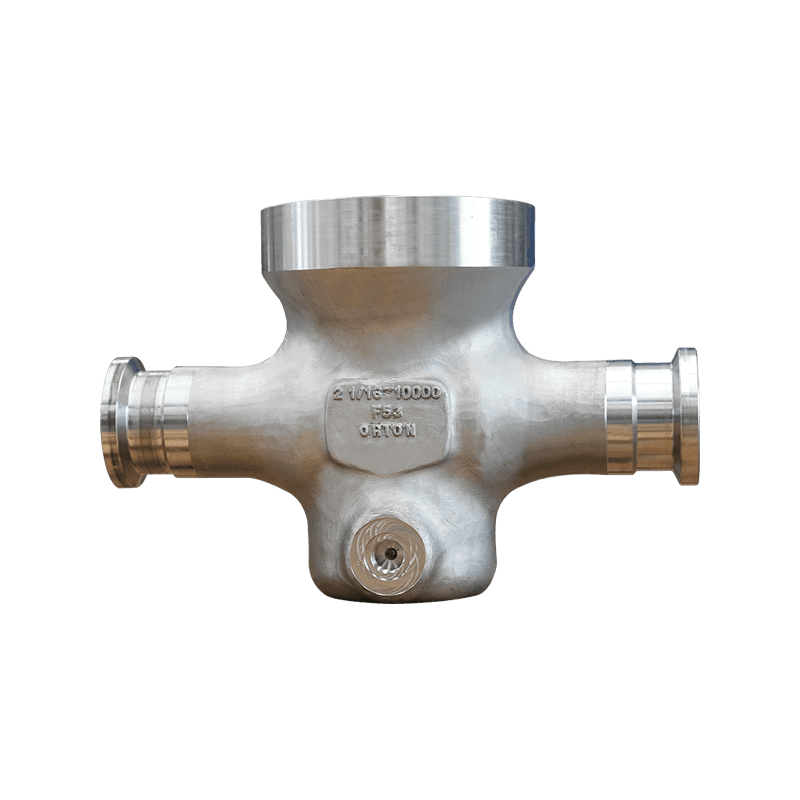
ASTM A694 covers high-yield-strength carbon and alloy steel forging grades — designated F42, F52, F60, F65, and F70, where the number indicates minimum yield strength in ksi — used specifically for high-pressure gas and liquid pipeline fittings and valve bodies in transmission pipeline service. These grades are used when the pressure class and pipeline design code require a higher yield strength than A105 provides, allowing thinner wall sections and lighter weight at equivalent pressure ratings. F65 and F70 are particularly common in high-pressure gas transmission valve applications where API 6D or ASME B31.8 are the governing codes.
Pressure Classes and End Connection Types
Forged ball valves are manufactured to defined pressure classes that specify the maximum allowable working pressure (MAWP) at a reference temperature, with the MAWP decreasing as temperature increases following published pressure-temperature tables. Understanding the pressure class system and correctly matching the valve class to the piping system design pressure is a fundamental requirement for safe valve selection — specifying a Class 800 valve in a system designed to Class 1500 rating is a serious engineering error with potentially catastrophic consequences.
Forged ball valves are commonly available in Class 800, 1500, 2500, and 4500 pressure classes per ASME B16.34. Class 800 is the most widely stocked and covers the majority of refinery and chemical plant process piping operating at pressures up to approximately 138 bar (2,000 psi) at ambient temperature in carbon steel. Class 1500 extends to approximately 260 bar (3,750 psi) at ambient, Class 2500 to approximately 430 bar (6,250 psi), and Class 4500 is a high-pressure specialty class used in hydraulic systems, wellhead equipment, and high-pressure gas injection service. For pipeline service governed by API 6D, valves are rated by ANSI Class 150 through Class 2500, with the pressure-temperature rating tables differing slightly from ASME B16.34 values at the same class designation.
End Connection Options
Forged ball valves are available with several end connection types, and the selection should be matched to the piping system's jointing philosophy, pressure class, and maintenance approach:
- Socket weld (SW): The most common end connection for small-bore forged valves in sizes up to DN50 (2"). The pipe slides into a socket bored into the valve end connector and is fillet-welded around the outside. Provides a strong, leak-tight, permanent joint suitable for high-pressure and vibration service. Not suited for services requiring frequent valve removal.
- Butt weld (BW): The valve end is prepared with a beveled weld end matching the mating pipe, and a full-penetration butt weld joins them. Produces the strongest possible joint and is preferred for safety-critical services, high-pressure gas, and corrosive services where crevices in socket welds could cause concentrated corrosion.
- Threaded (NPT or BSP): Tapered pipe threads cut into the valve end connector. Used for low-pressure utility service, instrumentation, and small-bore auxiliary piping where the convenience of threaded connection outweighs the lower pressure and fatigue resistance compared to welded connections. Not recommended above Class 600 rating or in cyclic thermal service.
- Flanged: Raised-face, ring-type joint, or flat-face flanges bolted to mating flanges in the piping system. Provides the greatest ease of removal for maintenance and inspection, at higher weight and cost than welded connections. Common in three-piece forged valve configurations and in applications where regular valve removal is anticipated.
Seat Materials and Sealing Performance in Demanding Services
The seat material of a forged ball valve determines its temperature capability, chemical compatibility, sealing performance over life, and suitability for the specific fluid handled. Seat failure — from chemical attack, thermal degradation, or wear — is the most common cause of forged ball valve leakage in service, making seat material selection as important as body material specification for long-term reliability.
PTFE and Modified PTFE Seats
Polytetrafluoroethylene (PTFE) seats are the most widely used seat material in forged ball valves for general chemical service because PTFE is chemically inert to virtually all process chemicals at temperatures up to approximately 200°C, has an extremely low coefficient of friction that provides smooth ball operation, and produces bubble-tight shutoff per API 598 seat leakage test requirements. The limitation of standard PTFE in forged ball valve seats is cold flow — the material creeps and deforms under sustained compressive loading, causing the seat to conform to any minor surface irregularity on the ball and eventually leading to seat relaxation and leakage after several thermal cycles. Modified PTFE formulations — reinforced with glass fiber, carbon fiber, or graphite — significantly reduce cold flow and extend service life in high-cycling applications while maintaining most of PTFE's chemical compatibility advantages.
Metal Seats for High-Temperature and Cryogenic Service
Above approximately 200°C and in cryogenic service below −46°C where standard polymer seats lose their mechanical properties, metal seats are required. Metal-seated forged ball valves use hardened stainless steel, Stellite overlay, or tungsten carbide seat surfaces that contact a similarly hardened ball surface. The sealing mechanism relies on tight dimensional tolerances between the lapped ball and seat surfaces rather than the elastic deformation of a soft seat material, producing a metal-to-metal seal. Metal-seated valves provide reliable shut-off capability across extreme temperature ranges and are resistant to damage from abrasive particulates in the process stream that would quickly destroy soft PTFE seats. The trade-off is that metal-seated valves require higher operating torque and do not achieve the bubble-tight zero-leakage performance of soft-seated valves — they are typically rated to ANSI Class IV or Class V seat leakage rather than Class VI (bubble-tight).
Fire-Safe Design and Fire-Test Certification
Forged ball valves specified for flammable or combustible fluid service in refineries, petrochemical plants, and offshore facilities are required to be fire-safe — meaning that if the primary soft seat seal is destroyed by fire, the valve must maintain acceptable shutoff capability through a secondary metal-to-metal seal until the fire is extinguished and the valve can be replaced. Fire-safe design is achieved by incorporating a metal backup seat ring that contacts the ball when the primary PTFE seat has melted or burned, maintaining valve closure integrity under fire conditions. Fire-safe forged ball valves are tested and certified to API 607 (fire test for quarter-turn valves) or ISO 10497, which prescribes a specific fire exposure protocol and maximum allowable leakage rates through the valve seat and stem seal during and after the fire exposure period.
Key Standards Governing Forged Ball Valve Design and Testing
Forged ball valves in process industry service are designed, manufactured, and tested to a defined set of international standards that specify dimensional requirements, pressure-temperature ratings, material requirements, testing protocols, and marking requirements. Specifying compliance with the applicable standards — rather than simply specifying a "high-quality" valve — is the only way to ensure that valves from different manufacturers can be evaluated on a common technical basis and that the purchased valve meets the minimum requirements for safe, reliable operation in the intended service.
- ASME B16.34: The primary design standard for pressure-temperature ratings, wall thickness, and testing requirements for valves in flanged, threaded, and welding-end configurations. Forged ball valves to this standard must be hydrostatically shell-tested at 1.5× the rated working pressure and seat-tested at 1.1× rated working pressure before shipping.
- API 6D: The pipeline valve standard governing design, manufacturing, testing, and inspection of ball valves used in oil and gas transmission and distribution pipelines. API 6D requires extended body testing including low-pressure gas seat tests, high-pressure liquid seat tests, and trunnion integrity tests not mandated by ASME B16.34.
- API 598: Defines valve inspection and testing requirements including seat leakage classes — from Class I (metal seat general industrial) through Class VI (soft seat bubble-tight) — and specifies the test pressure and permitted leakage rate for each class. Seat leakage class per API 598 must be explicitly specified when ordering forged ball valves.
- API 607: Fire-test standard for quarter-turn valves and actuators. Specifies the fire exposure conditions and maximum allowable external leakage and seat leakage rates that a fire-safe valve must meet during and after the prescribed fire test protocol.
- NACE MR0175 / ISO 15156: Material requirements for valves used in sour service — process streams containing hydrogen sulfide (H₂S). These standards restrict which alloys and heat treatment conditions are permitted in contact with sour fluids, to prevent sulfide stress cracking (SSC) and hydrogen-induced cracking (HIC) that cause rapid brittle failure of susceptible materials. Specifying NACE compliance for a forged ball valve in sour service is mandatory and affects body, trim, stem, and spring material selection.
Selecting and Specifying Forged Ball Valves: A Practical Checklist
Correctly specifying a forged ball valve for a process application requires working through a defined set of parameters in a logical sequence. Missing or incorrectly specifying any of these parameters results in either an unsafe valve selection or a valve that is over-specified and unnecessarily expensive for the service. The following checklist covers the essential specification items for any forged ball valve procurement.
- Service fluid and phase: Identify the fluid, its phase (liquid, gas, two-phase), and any special properties — corrosivity, toxicity, flammability, H₂S content, chloride content, solids content — that affect material selection and design requirements.
- Operating and design pressure and temperature: Specify both normal operating conditions and the maximum allowable design conditions — these determine the required pressure class per ASME B16.34 or API 6D pressure-temperature tables for the selected body material.
- Valve size and bore: Specify nominal diameter and whether full-bore (valve bore equals pipe bore) or reduced-bore (ball bore is one pipe size smaller) is required. Full-bore forged valves are required where pigging, in-line inspection tools, or minimum pressure drop is the priority; reduced-bore valves are smaller, lighter, and lower cost where these constraints do not apply.
- Body material and ASTM grade: Select the forging material grade based on service fluid corrosivity, temperature, weldability, and applicable codes. Specify the ASTM grade (e.g., A105N, A182 F316L, A694 F65) explicitly — do not specify only "stainless steel" or "carbon steel."
- Seat and trim material: Specify seat material and hardness — PTFE, modified PTFE, metal-seated with specified overlay material — based on temperature range, chemical compatibility, and required seat leakage class per API 598.
- End connection type and standard: Specify socket weld, butt weld, threaded, or flanged end connections with the applicable standard (e.g., SW to ASME B16.11, BW to ASME B16.25, RF flanged to ASME B16.5).
- Design and testing standards: Specify the applicable design standard (ASME B16.34 or API 6D), inspection and testing standard (API 598), and any additional requirements — fire-safe per API 607, sour service per NACE MR0175, low-temperature impact testing, or third-party inspection by a named inspection authority.
- Actuation requirement: Specify whether the valve will be manually operated (lever or gear operator), or actuated (pneumatic, hydraulic, or electric actuator), and if actuated, whether fail-safe direction (fail-open or fail-closed) and position feedback are required.
Providing this complete specification to a valve manufacturer or distributor — rather than simply requesting a price for a "2 inch Class 1500 ball valve" — eliminates the assumptions that lead to incorrect material selection, inadequate testing, and post-purchase disputes about what was actually supplied. In hazardous and high-pressure service applications, a complete valve specification is not administrative overhead — it is a fundamental engineering safety requirement.
