


 русский
What Is API 6D and Why Do Its Valve Components Matter?
API 6D is the American Petroleum Institute standard that governs the design, manufacturing, assembly, testing, and documentation of pipeline valves used in the oil and gas transmission industry. Formally titled "Specification for Pipeline and Piping Valves," API 6D applies to ball valves, gate valves, check valves, and plug valves intended for use in liquid and gas hydrocarbon pipelines operating under high pressure and demanding environmental conditions. The standard defines not only how finished valves must perform but also the precise requirements for every internal and external component that makes up an API 6D-compliant valve assembly.
Understanding the individual components of API 6D pipeline valves is essential for procurement engineers, maintenance teams, and valve manufacturers alike. Each part — from the body casting to the seat ring to the stem packing — must meet specific material, dimensional, and performance criteria to ensure the valve delivers reliable shutoff, withstands operating pressures up to Class 2500 (approximately 420 bar), and survives decades of service in corrosive or high-cycle environments. A single substandard component can compromise the integrity of an entire pipeline segment, making component-level knowledge a practical operational necessity.
Primary Structural Components of API 6D Valves
The structural backbone of any API 6D pipeline valve consists of several pressure-containing and load-bearing parts that must collectively withstand full rated working pressure, thermal cycling, and mechanical stress from pipeline installation and operation.
Valve Body
The valve body is the primary pressure-containing component and the largest structural element in an API 6D valve assembly. It houses the closure element (ball, gate, or plug), provides the flow passage, and connects the valve to the pipeline via flanged, butt-weld, or socket-weld end connections. API 6D bodies are manufactured from carbon steel (ASTM A216 WCB/WCC), low-temperature carbon steel (ASTM A352 LCB/LCC), stainless steel (ASTM A351 CF8M), or duplex/super-duplex alloys for sour service environments. Bodies are either one-piece, two-piece, or three-piece configurations depending on valve type and pressure class, with three-piece split-body designs being common in large-diameter ball valves to facilitate maintenance without removing the valve from the pipeline.
Bonnet and Body Cap
The bonnet is the upper pressure-containing cover that encloses the stem area and provides the primary seal between the valve interior and atmosphere. In gate valves, the bonnet also supports the stem and packing assembly. API 6D requires bolted bonnet connections with full-face or raised-face gaskets for Class 150 through Class 600, while higher pressure classes typically use ring joint (RTJ) gaskets for enhanced sealing integrity. Body caps in ball valves serve an analogous function, closing the body cavity ends while retaining the ball and seat rings. Both bonnets and body caps must be manufactured from materials compatible with the body to prevent galvanic corrosion and ensure matched thermal expansion coefficients.
End Connections and Flanges
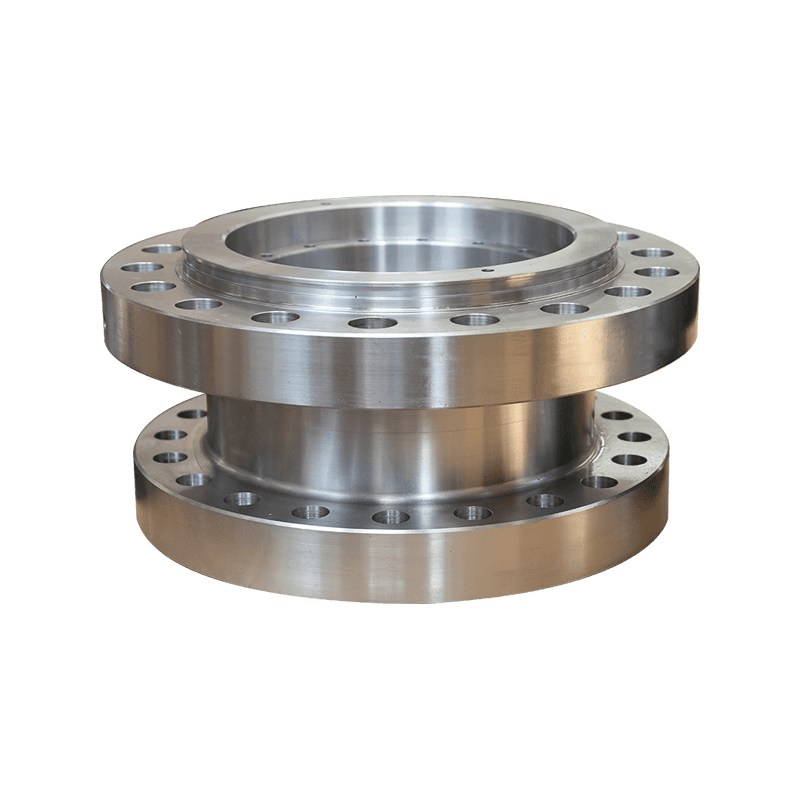
API 6D specifies that valve end connections must conform to ASME B16.5 (flanged connections up to NPS 24), ASME B16.47 (large-diameter flanges NPS 26 and above), or ASME B16.25 (butt-weld ends). Flanges are machined integrally with the body or welded, and face types — flat face, raised face, or ring-type joint — must match the pipeline flange specification. Butt-weld end connections are common in offshore and buried pipeline applications where flange leakage risk must be minimized. The wall thickness at weld ends must meet ASME B31.4 or B31.8 pipeline design requirements, and a bevel angle of 37.5° is standard for most butt-weld preparations.
Closure Elements: Ball, Gate, and Plug Components
The closure element is the active component that controls flow through the valve. Its geometry, surface finish, and material directly determine sealing performance, operating torque, and service life. API 6D covers three primary closure element types across its scope.
Ball (for Ball Valves)
The ball is a spherical closure element with a through-bore that aligns with the flow passage when open and rotates 90° to block flow when closed. API 6D ball valves use either a floating ball design — where the ball moves slightly under pressure to seat against the downstream seat ring — or a trunnion-mounted ball design, where the ball is fixed on upper and lower trunnion bearings and seats are spring-loaded to contact the ball. Trunnion-mounted designs are standard for larger bore sizes (typically NPS 6 and above) and higher pressure classes where the seating force required in a floating design would generate excessive operating torque. Balls are typically manufactured from AISI 316 stainless steel, duplex stainless steel, or carbon steel with hard overlay (Stellite 6 or tungsten carbide) on seating surfaces to resist erosion and galling.
Gate (for Gate Valves)
The gate is a wedge-shaped or parallel-sided disc that slides perpendicular to the flow stream to block or permit passage. API 6D gate valves used in pipeline service are predominantly slab gate or expanding gate designs. A slab gate is a flat, single-piece disc with a through-port that aligns with the seats in the open position. An expanding gate uses a two-segment mechanism (gate and segment) that expands outward when the valve reaches full open or full closed position, creating a positive seal against both upstream and downstream seats — a feature essential for double-block-and-bleed (DBB) applications. Gate surfaces must achieve a specific surface roughness (typically Ra ≤ 0.8 µm on seating faces) and are commonly hard-faced with Stellite or electroless nickel plating to resist scoring from entrained solids.
Plug (for Plug Valves)
The plug is a tapered or cylindrical element with a transverse port that rotates within the valve body to control flow. Lubricated plug valves use a sealant injected under pressure between the plug and body to maintain sealing, making them suitable for abrasive and corrosive services. Non-lubricated designs rely on PTFE or reinforced polymer sleeve liners. API6D Valve Components are used in pipeline applications requiring multi-port configurations or compact installation where the 90° quarter-turn operation of a ball valve is preferred but a spherical closure element is not practical.
Seat and Sealing Components in API 6D Pipeline Valves
Seating and sealing components are among the most technically critical elements in any API 6D valve. They are responsible for achieving and maintaining the leak-tightness classifications required by the standard — Rate A (no visible leakage) being the most stringent for gas service, and Rate B (defined maximum leakage volume) for liquid service.
Seat Rings
Seat rings are annular sealing elements positioned within the valve body that contact the ball or gate surface to form the primary fluid seal. In trunnion-mounted ball valves, seat rings are spring-loaded using wave springs or coil springs to maintain constant contact with the ball surface regardless of pressure differential direction. Seat ring materials must be selected based on process fluid, temperature, and abrasion resistance requirements. Common materials include PTFE (suitable up to 200°C), reinforced PTFE with glass or carbon fiber fill, PEEK (polyether ether ketone) for higher temperature service, and metal-to-metal seats in Stellite or Inconel hard facing for high-temperature, high-erosion applications. API 6D requires seat rings to be replaceable in the field, which is a key design consideration that differentiates pipeline valves from general-purpose industrial valves.
Stem Seals and Packing
The stem packing system prevents process fluid from leaking along the stem to atmosphere — one of the most common sources of fugitive emissions in pipeline valve installations. API 6D requires stem seals that conform to ISO 15848 or API 622 fugitive emission test protocols for valves in hydrocarbon service. Typical packing configurations use multiple rings of PTFE, flexible graphite, or braided carbon fiber arranged in a packing box with a follower plate and gland bolts that compress the packing radially against the stem. Live-loaded packing systems — where Belleville disc spring stacks maintain constant axial load on the packing — are increasingly specified to compensate for packing relaxation over time and reduce maintenance frequency. Injectable sealant fittings are often included in API 6D valves to allow emergency reseal without removing the valve from service.
Body Cavity Seals and Gaskets
Internal body cavity seals prevent cross-flow between the upstream and downstream pipeline bores when the valve is in the closed position — a requirement for double-block-and-bleed functionality. These seals are typically O-rings or lip seals in polymer or elastomeric materials (NBR, HNBR, FKM/Viton, EPDM) selected for compatibility with the process fluid and operating temperature. Bonnet gaskets and body-to-body-cap gaskets must meet the pressure and temperature ratings of the valve class and are commonly spiral-wound stainless steel/graphite or ring-joint (oval or octagonal) designs for Class 600 and above.
Stem and Actuation Components
The stem transmits mechanical torque or thrust from the operator or actuator to the closure element. API 6D specifies strict requirements for stem design, including anti-blowout features that prevent the stem from being ejected under pressure — a critical safety requirement that has been mandatory since the 2008 revision of the standard.
Stem Design and Anti-Blowout Feature
API 6D requires that the stem be designed so that it cannot be blown out of the valve body if the packing or bonnet connection fails while the valve is under pressure. This is achieved through a stem shoulder or collar that is larger in diameter than the stem bore — the stem is assembled from inside the valve body and physically cannot pass outward through the packing bore under pressure. Stems are typically manufactured from AISI 410 or 17-4PH stainless steel for corrosion resistance and mechanical strength, with duplex stainless steel or Inconel 625 specified for sour service or offshore environments where hydrogen sulfide (H₂S) exposure necessitates NACE MR0175 / ISO 15156 compliance.
Stem Bearings and Thrust Washers
Trunnion-mounted ball valves and large gate valves incorporate upper and lower stem bearings that reduce friction, support radial and axial loads, and maintain stem alignment during operation. These bearings are typically PTFE-lined stainless steel bushings or reinforced polymer thrust washers. Proper bearing specification is critical in large-diameter valves — NPS 16 and above — where stem loads are significant and operating torque directly affects actuator sizing and power consumption.
Operators and Actuator Mounting
API 6D valves are operated manually via handwheels, gear operators, or lever handles, or actuated by pneumatic, hydraulic, or electric actuators. The actuator mounting interface must conform to ISO 5211 (quarter-turn valves) or ISO 5210 (multi-turn valves) to ensure interchangeability between actuator manufacturers. Gear operators are required by API 6D for ball and plug valves above a defined torque threshold — typically NPS 6 Class 300 and larger — to ensure operability without excessive manual effort. Actuator-ready valve designs include a top flange, stem extension, and position indicator that facilitate direct actuator mounting without intermediate adapters.
Material Requirements for API 6D Valve Parts
API 6D specifies permissible materials for each valve component based on pressure class, temperature range, and service environment. The following table summarizes standard material designations for major API 6D pipeline valve components:
| Component | Standard Material | Low-Temp / Sour Service | High-Temp / Corrosive |
| Body / Bonnet | ASTM A216 WCB | ASTM A352 LCC | ASTM A351 CF8M (316SS) |
| Ball / Gate | AISI 316 SS | Duplex 2205 | Super Duplex / Inconel |
| Stem | AISI 410 SS / 17-4PH | Duplex 2205 | Inconel 625 |
| Seat Rings | PTFE / Reinforced PTFE | PEEK / Metal-seated | Stellite / Metal-to-metal |
| Packing | Flexible Graphite / PTFE | Flexible Graphite | Flexible Graphite (API 622) |
| Body Bolting | ASTM A193 B7 / A194 2H | ASTM A320 L7 / L43 | ASTM A193 B8M (316SS) |
| Gaskets | Spiral-wound SS/Graphite | Spiral-wound SS/Graphite | Ring Joint (Inconel 625) |
Auxiliary and Safety Components Required by API 6D
Beyond the core structural and sealing components, API 6D pipeline valves incorporate several auxiliary features that are either mandatory under the standard or widely specified by pipeline operators for operational safety and functionality.
- Cavity relief (self-relieving seats): API 6D requires that trunnion-mounted ball valves and double-block-and-bleed gate valves provide a means of relieving thermal pressure buildup in the body cavity when the valve is closed. This is achieved either through a self-relieving seat design — where a seat ring lifts off its seating face when cavity pressure exceeds line pressure — or through an external cavity relief valve. Unrelieved thermal expansion of trapped fluid in the body cavity can generate pressures far exceeding the valve's pressure rating.
- Bleed and drain connections: API 6D mandates body cavity bleed and drain connections — typically a threaded or flanged port — to allow operators to verify double-block isolation, drain the cavity before maintenance, or inject sealant. These connections are equipped with isolation valves (needle valves or plug-type fittings) conforming to API 6D or equivalent standards.
- Sealant injection fittings: Injectable sealant connections are incorporated into the seat area and stem packing area of API 6D valves, allowing emergency injection of sealant compound to restore sealing performance in the event of seat or packing degradation without removing the valve from the pipeline.
- Locking devices: API 6D requires that valves be capable of accepting a lock in both the open and closed positions to prevent unauthorized or accidental operation. This is achieved through a lock plate integrated into the operator or gear box that accepts a padlock shackle through a hole aligned with a fixed body bracket in each end position.
- Position indicators: All API 6D valves must provide a clear and unambiguous indication of the valve position (open or closed) visible from the operating position. Quarter-turn valves use a stem flat or notch aligned with the flow bore, with a position indicator plate; multi-turn gate valves use a rising stem (which visually indicates position) or an external mechanical indicator on non-rising-stem designs.
- Stem extension: For buried service valves, stem extensions — either fixed or telescoping — are used to bring the operating interface to ground level. API 6D specifies that stem extension designs must maintain the anti-blowout protection of the base valve stem and must not compromise stem sealing integrity.
Testing Requirements for API 6D Valve Components and Assemblies
API 6D mandates a comprehensive testing program for both individual components and complete valve assemblies before shipment. These tests verify the structural integrity of pressure-containing components and the sealing performance of all seating and packing systems.
- Shell hydrostatic test: Every API 6D valve must undergo a shell test at 1.5 times the rated working pressure using water (or another suitable test fluid) with the closure element in the partially open position. This test verifies the pressure integrity of the body, bonnet, body cap, and all pressure-containing welds and connections. No leakage is permitted through the valve body or any external connection during the test duration, which is a minimum of 15 minutes for valves NPS 2 and above.
- Seat leakage test: Seat leakage is tested from both sides of the closure element at 1.1 times the rated working pressure (high-pressure closure test) and at a low-pressure test of 80–100 psig (5.5–6.9 bar) to detect soft-seat leakage that may not be apparent at high pressure. Permissible leakage rates are defined by API 6D Rate A (zero leakage, gas) and Rate B (limited volumetric leakage, liquid).
- Backseat test: Gate valves with a backseat feature — where the stem shoulder seals against a corresponding surface in the bonnet when the valve is fully open — must be tested to verify backseat sealing integrity at 1.1 times the rated working pressure. This test confirms that the packing can be replaced while the valve is in service under pressure with the backseat engaged.
- Material certification and traceability: All pressure-containing and pressure-controlling API 6D valve parts must be supported by material test reports (MTRs) traceable to individual heat or lot numbers. Chemical composition and mechanical properties must be verified against the applicable ASTM or equivalent material specification, with original mill certificates retained in the valve documentation package.
Common API 6D Component Failure Modes and Preventive Practices
Even properly specified and installed API 6D valve parts can experience degradation over time. Understanding the most common failure mechanisms helps maintenance engineers prioritize inspection intervals and spare parts inventory.
- Seat erosion: In pipelines carrying sand-laden crude oil or wet gas, soft PTFE seats erode rapidly when particles impinge on the seating surface at high velocity. Upgrading to reinforced PTFE, PEEK, or metal-to-metal seats with hard overlay significantly extends service life in these conditions.
- Stem packing fugitive emissions: Packing degradation is accelerated by thermal cycling, stem surface corrosion, and inadequate initial compression. Implementing live-loaded packing systems and scheduling packing replacement every 3–5 years (or per API 622 test cycle equivalent) reduces fugitive emission incidents significantly.
- Body cavity pressure buildup: Self-relieving seats that become stuck due to debris or polymer degradation fail to relieve trapped pressure, risking seat or body deformation. Regular bleed valve testing and sealant injection system maintenance prevent this failure mode in trunnion-mounted ball valves.
- Corrosion of bolting: External body bolting on buried or subsea valves is highly susceptible to galvanic and crevice corrosion. Specifying B7M/2HM bolting for sour service, using fluoropolymer-coated fasteners, and applying cathodic protection where applicable dramatically reduces bolt failure risk and ensures the valve can be disassembled for maintenance.
- Ball or gate surface galling: Galling occurs when the ball or gate surface is scored by contact with seat rings during operation under insufficient lubrication or with contaminated process fluid. Specifying hard-faced closure elements (Stellite 6 overlay or HVOF tungsten carbide) and maintaining filter/separator function upstream of critical isolation valves are the most effective preventive measures.
