


 русский
What is Ring Forging?
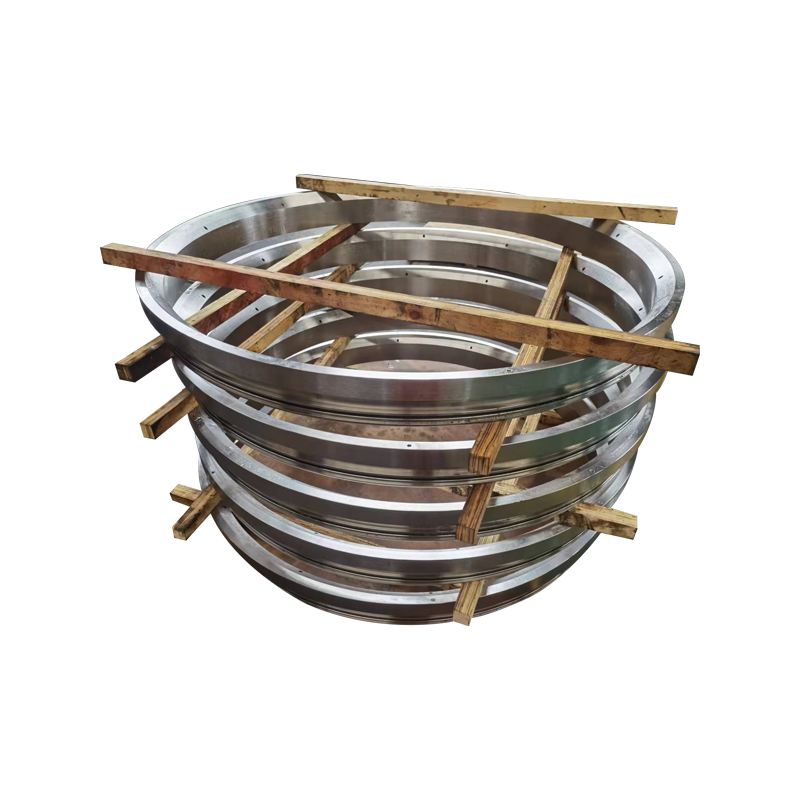
Ring forging is a metal forming process that manufactures seamless, circular components, known as forged rings or ring forgings. Unlike parts made by welding or casting, the forging process uses immense compressive force to shape the metal while it is hot. This process rearranges the internal grain structure of the metal, eliminating imperfections like voids or porosity, and aligning the grain flow to match the ring’s contour. The result is a component with superior strength, toughness, and fatigue resistance.
The Forging Process: A Symphony of Heat and Pressure
The creation of a forged ring involves several precise steps, transforming a raw slug of metal into a high-performance part.
Starting Material: The Billet
The process begins with a solid piece of metal, often called a billet or slug. This material is carefully selected based on the final application, including various steels, aluminum, nickel alloys, and titanium.
Heating and Upsetting
The billet is heated to its plastic deformation temperature, which makes the metal malleable but still solid. The temperature is crucial—too cold, and the metal will crack; too hot, and it will lose its desired properties. The heated billet is then typically “upset” by compressing it between two dies to reduce its height and increase its diameter, preparing it for the next stage.
Piercing and Donut Formation
A punch then pierces the center of the upset block, creating a donut shape. This internal hole is what differentiates ring forging from disc forging.
Ring Rolling: The Defining Step
The pierced donut is placed on a mandrel (an internal roller) and rotated. An external roller, called the axial roll, then compresses the metal radially while other rolls control the height, gradually increasing the ring’s diameter and decreasing its wall thickness. This continuous rolling action is what creates the seamless, circular shape and establishes the crucial, concentric grain flow pattern.
Why Forged Rings Outperform Alternatives
The unique properties of Ring Type Forging make them indispensable in critical applications.
Superior Mechanical Properties
The most significant advantage of forging is the creation of a continuous, aligned grain flow. Imagine the metal’s internal structure as wood grain; in a forged ring, this grain follows the circular shape, making the ring exceptionally strong and resistant to stress in all directions, especially when subjected to rotational forces.
Seamless Integrity
Because the ring is shaped from a single piece of metal without welding, it has no weak seams or joints. Welded rings are prone to failure at the weld point under high stress or fluctuating loads, a risk completely eliminated by the seamless forging process.
Economical for High-Volume and Large Components
While the initial setup for forging can be more complex than casting, the process offers excellent material utilization. For large diameter rings, especially those used in industrial machinery, the ability to create near-net shapes reduces the amount of material that needs to be machined away, saving time and cost.
Applications: Where Ring Forgings Live
Ring forgings are the unsung heroes found in demanding environments across numerous industries.
Aerospace and Defense
In aircraft, forged rings are critical components of jet engine casings, rotating turbine discs, and rocket motor components. The need for extreme heat resistance, high strength-to-weight ratio, and zero failure tolerance makes forging the only viable option for these parts, often using exotic materials like nickel and titanium alloys.
Industrial Machinery and Energy
Large ring forgings are essential for gear blanks in heavy equipment, slewing bearings for wind turbines, and flanges in high-pressure piping systems. In the energy sector, they form the main structural components of pressure vessels and nuclear reactor parts, where material integrity is paramount.
Transportation
From the railway industry, where they are used in locomotive and railcar wheel hubs, to high-performance automotive applications, ring forgings ensure reliability and safety under constant heavy load and dynamic stress.
